MatchMaker Review
Can Mathematics Produce Fairer Small-Sided Football Teams?
This review was first published on FootballMatchMaker's website. It aims to assess the app critically, including its strengths, weaknesses and the evidence still required to validate its claims.
There is no shortage of software that will divide footballers into teams. MatchMaker, a newly launched iPhone and Android app, goes further: it aims to make those teams genuinely competitive and to use previous results to improve future player assessments.
MatchMaker is designed for regular small-sided football — or pickup soccer in the US — where a squad picks teams from among itself rather than playing in a league. It supports 4, 5, 6 and 7-a-side games, including unequal sides such as 4v5, and combines ability-based team selection with team-sheet sharing, results and player statistics.
Its creator, Phil Peters, is 66, has a Mathematics degree from Imperial College London and still plays every Wednesday with the Strollers. Formed in 1985 and joined by Peters in 1995, the Strollers now have more than 50 members, ranging from teenagers to players in their 60s, and play formats from 4-a-side to four-team 7-a-side tournaments. Peters also spent two years working with Apple’s Mac design team before the Mac launched, an influence he says helped make MatchMaker user-friendly.
For several years the Strollers recorded results and who picked the teams, using the final score as a simple measure of selection quality: 5–4 was good; 7–1 was not.
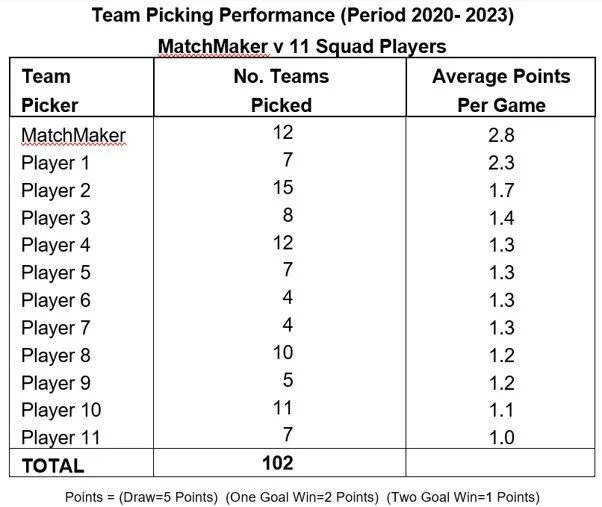
Peters initially modelled MatchMaker in spreadsheets for two years before spending another three years developing the iPhone and Android app. Five years may sound excessive for dividing players into teams, but the possibilities rise quickly: there are only 35 ways to select a 4-a-side team, but 1,716 ways to select a 7-a-side team from 14 players.
The problem with random teams
Random does not mean balanced. If ten players include three particularly strong footballers, a random draw can put all three together. Redrawing until the teams “look right” merely returns the organiser to subjective judgement.
MatchMaker instead treats selection as a balancing problem, using player abilities to make the teams’ overall strengths as close as possible. Skill-based balancing is not unique, so the more useful comparison is with apps that could realistically replace it.
Defining the competition
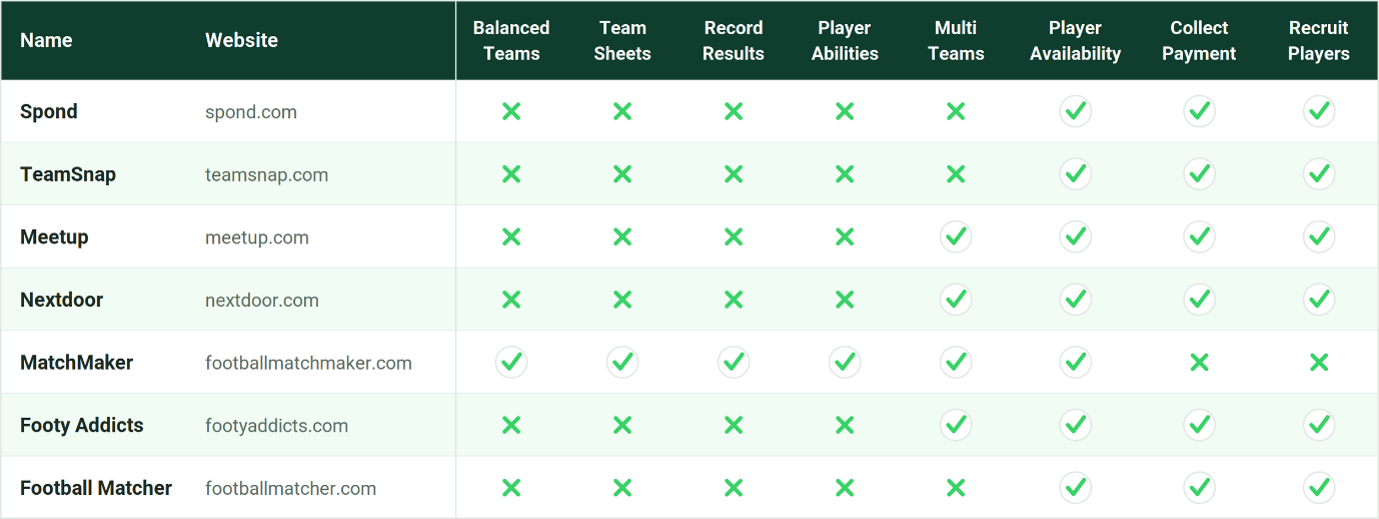
This review deliberately excludes two categories of apparent competitor. First, it excludes products available only on the web or desktop rather than on both iPhone and Android. Recreational teams often change on the pitch just before kick-off: somebody is late, drops out or unexpectedly arrives. The picker may need to rebalance the sides immediately, and a laptop is little use then.
Second, it excludes apps whose structure effectively assumes that a player belongs to only one team. Many small-sided players belong to two, three or more groups. MatchMaker allows a player to be associated with multiple teams.
Applying both tests — genuine iPhone and Android availability and support for players in multiple teams — considerably narrows the field of direct competitors. Web-only products and single-team systems are not necessarily poor products; they simply solve a different problem.
Only one person actually needs MatchMaker
Adoption is a potential weakness of any specialist sports app. A squad of 20 or 30 may already organise itself by email, WhatsApp or another messaging service, and persuading everyone to install and maintain another account is a high barrier. MatchMaker avoids much of this: only the team picker needs the app, and can create the team and add the other players by name.
Those players can join if they wish. They can then pick teams themselves, review previous matches and player statistics, or pick teams for one group while simply playing in three or four others. MatchMaker can therefore start with one organiser and spread through a squad without requiring everyone to change behaviour on day one.
More than a team generator
MatchMaker’s strongest idea is that team selection is not the end of the process. If supposedly even teams repeatedly produce comfortable wins for one side, the player assessments need questioning. The organiser selects those available, MatchMaker creates balanced sides, players can be swapped, and the team sheet can be shared.
After the game, the result and goalscorers are recorded and statistics accumulate, including games played, goals per game, win percentage and overall ability. Its support for 4, 5, 6 and 7-a-side football — including unequal teams such as 4v5 — also reflects recreational reality: twelve players may be expected and only eleven arrive. MatchMaker is closer to a lightweight football-management system than a disposable random-team generator.
Mathematics helps — but the pitch is the test
A sophisticated algorithm can still fail if its inputs are wrong, and football ability is difficult to reduce to a number. A gifted striker, dependable defender and outstanding goalkeeper contribute differently.
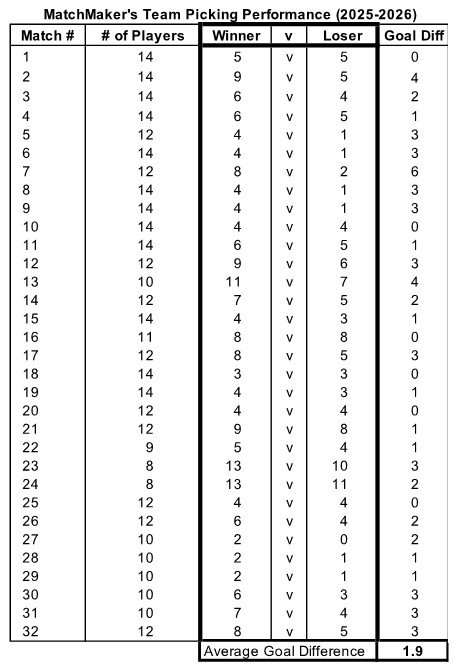
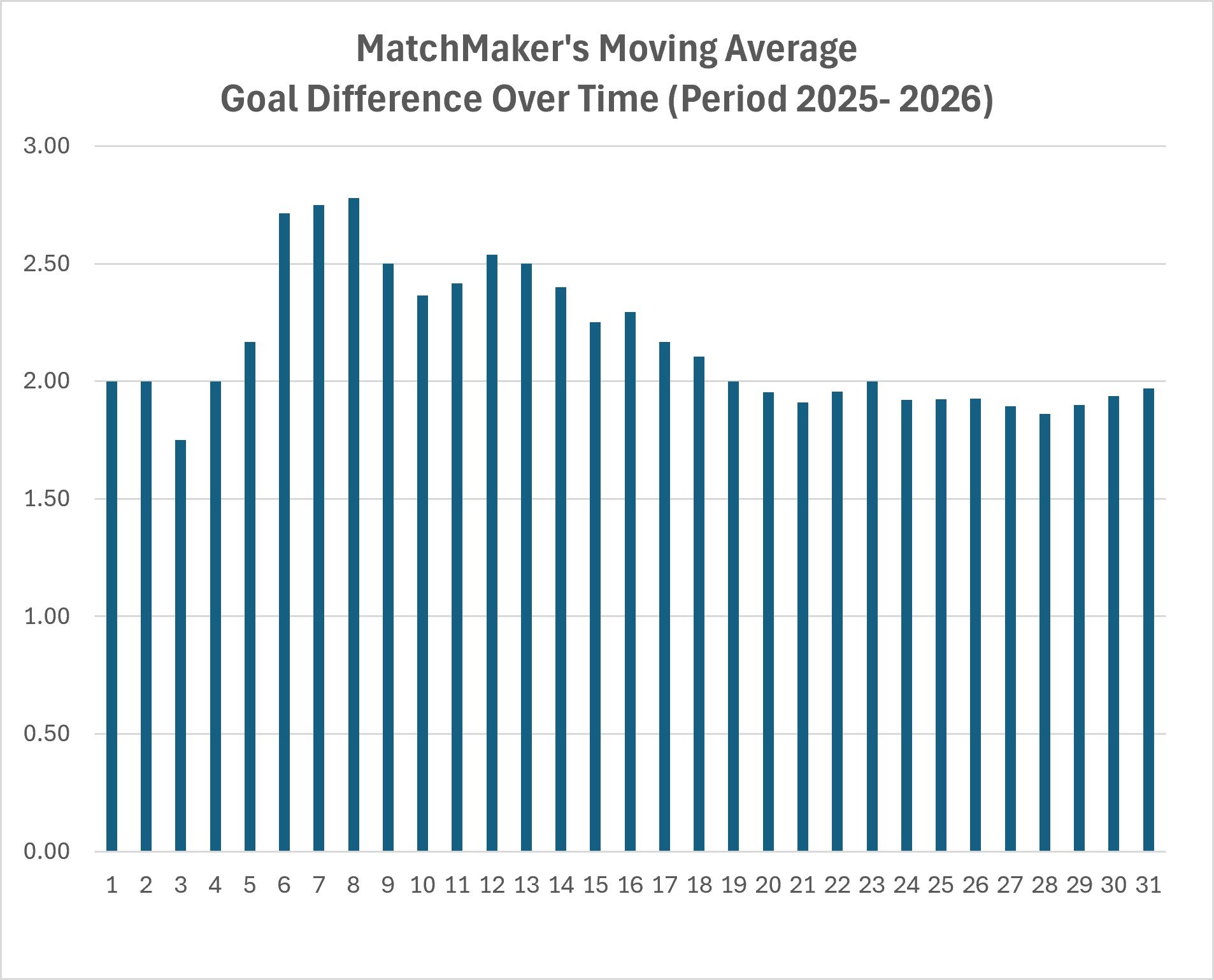
Ultimately, MatchMaker should be judged by results. If its games consistently produce smaller goal differences than conventionally selected games, that is objective evidence that the system works. The Strollers’ historical and more recent match data provide an early test.
MatchMaker rates forwards using goals per game. Defenders and goalkeepers are harder because recreational football lacks the detailed metrics produced by services such as Opta, so the team picker rates each player’s defensive ability. A goal-hanging centre-forward may therefore score highly for goals per game but poorly for defence.
A genuinely useful niche
The underlying problem is real. Anyone who has organised regular 5-a-side recognises the difference between a 5–4 game that remains competitive to the final kick and a match effectively over at 5–0. Many players avoid picking teams because they do not want the criticism that comes with getting it wrong. Regular groups also mix ages, fitness levels, abilities, relatives, long-standing friends and newcomers, making manual selection more complicated than simply identifying the best players.
The Strollers illustrate that challenge: the group has existed since 1985, Peters has played since 1995, and its pool spans generations as original players retire or move away and sons, daughters, friends and newcomers join. Remembering and continually updating everyone’s relative ability becomes difficult.
MatchMaker still faces a formidable competitor: doing nothing
MatchMaker’s biggest commercial competitor may be Meetup, WhatsApp, Nextdoor, a spreadsheet, a piece of paper or an experienced player saying, “I’ll pick the teams.” For many groups that works. If someone has picked every Wednesday for ten years and games are usually close, the incentive to adopt specialist software is limited.
MatchMaker must therefore make organising easier, produce noticeably better games, or preferably both. Its low adoption barrier helps: because only the picker needs the app, the organiser can continue distributing information through the group’s existing communication channels.
The multi-team approach is more important than it first appears
A less glamorous feature may be one of MatchMaker’s most useful. Recreational players often play 5-a-side with colleagues on Monday, with friends on Wednesday and 7-a-side at the weekend. A “one player equals one team” model handles this badly; sharing the same player data across multiple teams is more powerful.
A player introduced to MatchMaker through one group can therefore use it with another without starting again with a separate identity. It is not an exciting App Store screenshot, but it fits the target market.
Where MatchMaker still needs evidence
The app has just launched, so there is not yet a large public body of independent App Store and Google Play ratings, retention data, adoption figures or evidence of the active user base. Most importantly, the central proposition — that MatchMaker produces genuinely balanced matches — still needs broader validation from results.
Verdict
MatchMaker is a thoughtful attempt to solve a genuine recreational football and pickup-soccer problem. Its strengths are ability-based selection, mobile use at the pitch, support for 4–7-a-side and uneven teams, multi-team membership, results and statistics, and the fact that only the picker must install it. Its five-year development history and the Strollers data suggest more thought has gone into the problem than the phrase “team generator” implies.
The weaknesses are equally real. Football ability is hard to quantify; defensive ratings retain subjective input; established habits are hard to change; and immediately after launch MatchMaker lacks the large body of independent users, reviews and published results needed to validate its claims. It must beat not only other apps but the simplicity of an experienced organiser and WhatsApp.
Most importantly, the mathematics now has to face the football. If historical and future match data show that MatchMaker consistently produces smaller goal differences and fewer one-sided games, the app will have something stronger than a marketing claim: measurable evidence that its definition of a balanced team produces a balanced match. Until then, the assessment is positive but deliberately qualified.
Sign up for early access
〰️
Sign up for early access 〰️
Join up to 5 teams (4 to 7-a-side).
Add up to 100 players to each team.
MatchMaker is available free of charge during its initial launch period.
MatchMaker is currently, free to download and use. Until we add a paid-for subscription capability to MatchMaker, all features will remain completely free. After a subscription service is launched, everyone using MatchMaker will get a further 3 months' free to decide if they want to pay for a subscription.